Share:
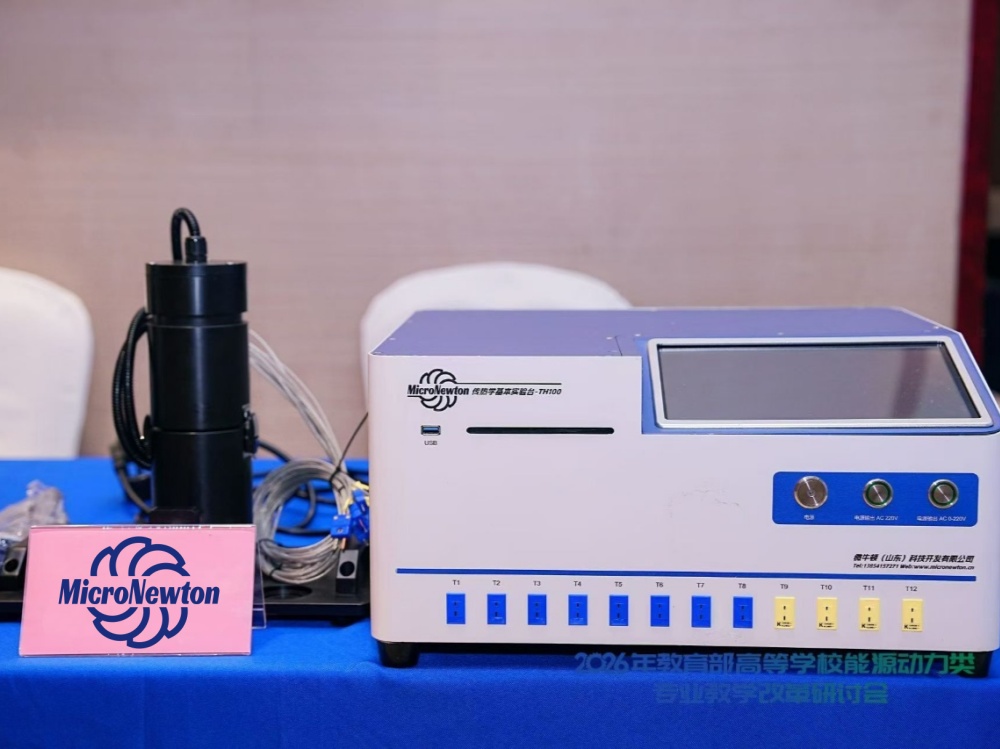
Chengdu: Our company was invited to the national seminar on teaching reform for energy and power programs, where we brought a compact selection of heat transfer and thermodynamics lab rigs. Rather than presenting a full product catalog, the team met the teachers who run thermal laboratories and discussed what the revised syllabi now require.
Who Joined the Seminar
The event brought deans, program directors, and laboratory teachers from energy and power engineering departments across the country, with colleagues from thermal engineering, new energy science, refrigeration and cryogenics, and power engineering. These are the staff who decide how many practical hours a heat transfer course should include and how much data a student should collect before trusting a textbook equation.
The first was the linear heat conduction experiment module. A steady heat flux passes through a metal bar, students read temperatures at several points along it, and derive thermal conductivity from the measured gradient. It is the simplest setup in the series, yet it makes Fourier law visible on the bench rather than only on the page.
The second was the convection and radiation heat transfer experiment module. Students compare natural convection with radiant heat exchange, vary surface temperature and emissivity, and approach the Stefan Boltzmann relation from their own readings. Many visitors stopped here because their revised courses now demand quantitative radiation work instead of demonstrations.
The two exhibited modules belong to wider product families. The table below shows the range departments can draw from.
|
Series |
Models |
Main topics |
|---|---|---|
|
Heat transfer series |
16 models |
conduction, convection, radiation, air heating and cooling |
|
Engineering thermodynamics series |
7 models |
ideal gas processes, real gas critical behavior, specific heat, Rankine cycle |
|
Related fields |
optional modules |
new energy and storage, fluid mechanics, aerodynamics, wind tunnels, combustion, refrigeration, air conditioning and heat pumps |
Browse the complete heat transfer series and the engineering thermodynamics series for the full experiment list.
Visitors asked about fit more than features. A rig must match the revised syllabus, record data a student can export and plot, and remain safe in a normal teaching laboratory at ambient pressure. It should also train undergraduates to read thermometers, flow meters, and pressure gauges and to write reports built from their own measurements.
Because the rigs are designed and built in our own workshop, the team can develop custom research equipment when a teaching reform plan calls for something beyond the standard catalog. The event ended with a short list of laboratory setups and a clear view of where energy and power teaching is heading. Departments planning a new laboratory can contact us for configuration and quotes.
Q1. What did the company present at the Chengdu seminar?
A1: The team showed a linear heat conduction experiment module and a convection and radiation heat transfer experiment module, drawn from a heat transfer series of sixteen models and a thermodynamics series of seven models.
Q2. What does the linear heat conduction module teach?
A2: Students pass a steady heat flux through a metal bar, read temperatures at several points, and calculate thermal conductivity from the measured gradient, making Fourier law visible on the bench.
Q3. What does the convection and radiation module cover?
A3: Students compare natural convection with radiant heat exchange, vary surface temperature and emissivity, and approach the Stefan Boltzmann relation using their own measurements.
Q4. Which departments and courses do the rigs match?
A4: The equipment matches energy and power engineering, thermal engineering, new energy science, refrigeration and cryogenics, and power engineering courses, along with heat transfer and thermodynamics labs.
Q5. Do the rigs export data for student reports?
A5: Yes. The rigs record data that students can export and plot, so reports are built from measured temperatures, flow rates, and pressure readings.
Q6. How many experiment models are available in total?
A6: The heat transfer series covers sixteen experiment models and the engineering thermodynamics series covers seven, with optional modules for new energy, fluids, aerodynamics, combustion, and refrigeration.
Q7. Can the company build custom research equipment?
A7: Yes. Because the rigs are designed and built in our own workshop, the team can develop custom equipment for teaching reform plans that need something beyond the standard catalog.
Q8. How can a department request a quote?
A8: Use the contact page to share your syllabus and laboratory requirements, and the team will recommend modules, configuration, and custom options.