Share:
A subsonic wind tunnel is a test facility that generates controlled subsonic speed airflow for investigating the aerodynamic performance of test models and surfaces.
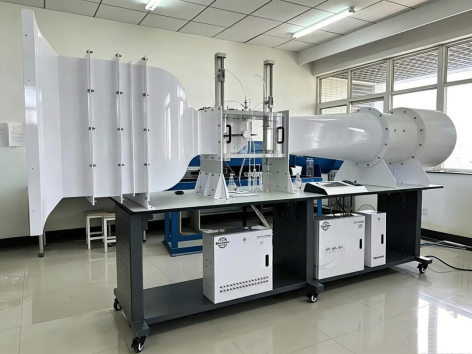
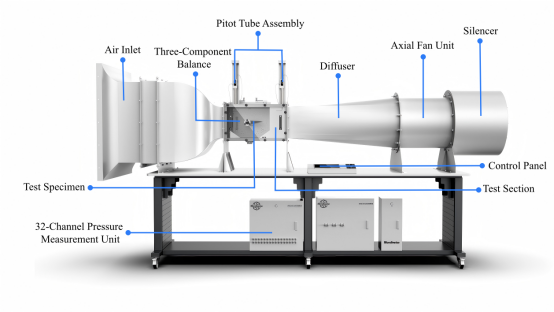
Air enters the wind tunnel via an aerodynamically optimized effuser, in which its velocity rises linearly. The air stream subsequently travels into the working test section, goes across a protective grille, flows through a diffuser, and arrives at a variable‑speed axial fan. Upon leaving the fan, the air moves through a silencer assembly before being released into the surrounding atmosphere.
The test section serves as the primary zone for experimental work. It supports installation of various model assemblies to fulfil diverse experimental and demonstration requirements.
For university teaching laboratories, subsonic wind tunnels deliver hands on experimental platforms to demonstrate core concepts of fluid mechanics and experimental aerodynamics.
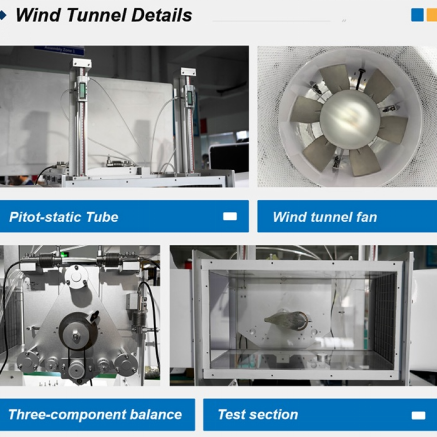
Our subsonic wind tunnel is engineered for lab based teaching and experimental research. It can be equipped with a three component force balance, 32-channel pressure measurement unit, pressure tapped NACA0012 airfoil model, boundary layer test model, 3D drag model and other accessories.
|
Parameter |
Technical Index |
|
Power Supply |
3 phase 5 wire, 380V±5%, 50 Hz |
|
Fan Rotation Speed |
0-2900 r/min |
|
Total Installed Power |
4.5 kW |
|
Test Section Flow Velocity |
0-33 m/s |
|
Pitot Tube |
2 pieces, Φ3 mm × 425 mm |
|
Traverse Displacement for Velocity Measurement |
Digital display; resolution: 0.01 mm; travel range: 0-300 mm |
|
Inlet Surface Roughness |
<0.5 |
|
Test Section Material |
Acrylic |
|
Test Section Length |
600 mm |
|
Test Section Cross Section (Length × Height) |
300 mm × 300 mm |
Custom built wind tunnel solutions are fully modified to match project specific client requirements.
If you plan to build a university level aerodynamics or fluid mechanics laboratory, our engineering team can configure a subsonic wind tunnel solution tailored to your teaching experiments, lab footprint and measurement needs.
A1: It is utilised to investigate airflow behaviours and aerodynamic performance under subsonic flow conditions, mainly for teaching purposes, scientific research and laboratory scale experiments.
A2: A subsonic wind tunnel runs at flow speeds below Mach 1, whereas a supersonic wind tunnel works at flow speeds above Mach 1.
A3: Typical tests include airfoil performance testing, lift and drag measurement, surface pressure distribution measurement, flow visualization and boundary layer research.
A4: A standard lab setup includes a subsonic wind tunnel, aerodynamic test models, pressure and force measurement hardware, and a data acquisition system.