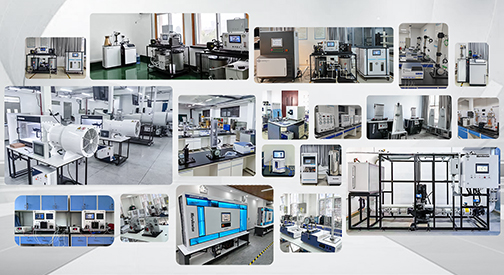
Flow Field Visualization Experimental Device Brings Invisible Fluid Motion to Life at Peking University College of Engineering
Share:
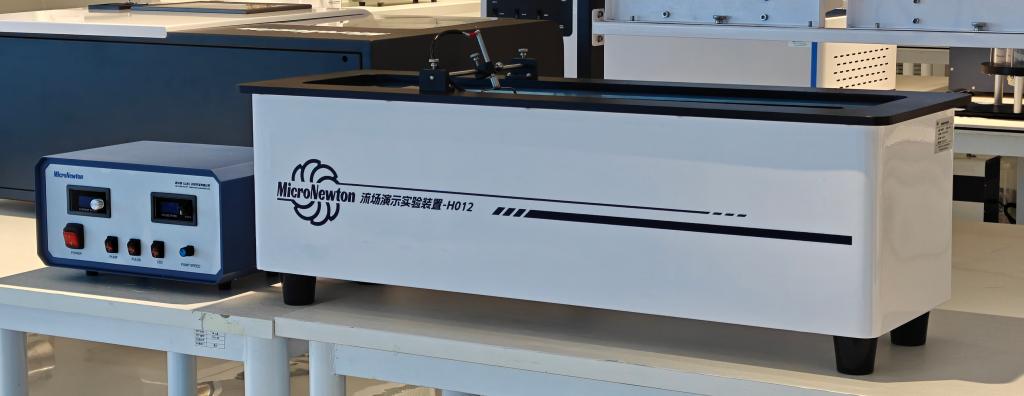
Fluid mechanics is a subject where critical phenomena such as laminar flow, turbulent flow, boundary layer separation, and vortex formation often remain invisible to students in a standard lecture setting. The College of Engineering at Peking University sought a compact teaching device that could make these abstract flow patterns directly observable in a classroom laboratory. MicroNewton provided the H012 flow field visualization experimental device, a self circulating water channel system that uses the hydrogen bubble method to render streamlines, separation zones, and vortex structures visible to the naked eye.
At the heart of the device is a small self circulating water tank measuring 900 by 300 by 300 millimeters, fitted with an ultra quiet variable speed water pump that delivers a maximum flow of 40 liters per minute with precise speed adjustment. A rectifier mechanism upstream produces a low turbulence stable flow field. Visualization is achieved through electrolysis: a pulsed power supply with frequency from 0 to 150 kilohertz and pulse width from 1 to 100 percent generates fine hydrogen bubbles at a platinum cathode wire upstream of the test model. These bubbles trace the flow, and LED backlighting produces high contrast images that make separation and vortex formation clearly visible. The system includes a control unit measuring 330 by 220 by 170 millimeters, interchangeable models including cylindrical, rectangular, NACA2412 airfoil, spindle, S shaped, and contraction profiles, and operates at 200 watts.
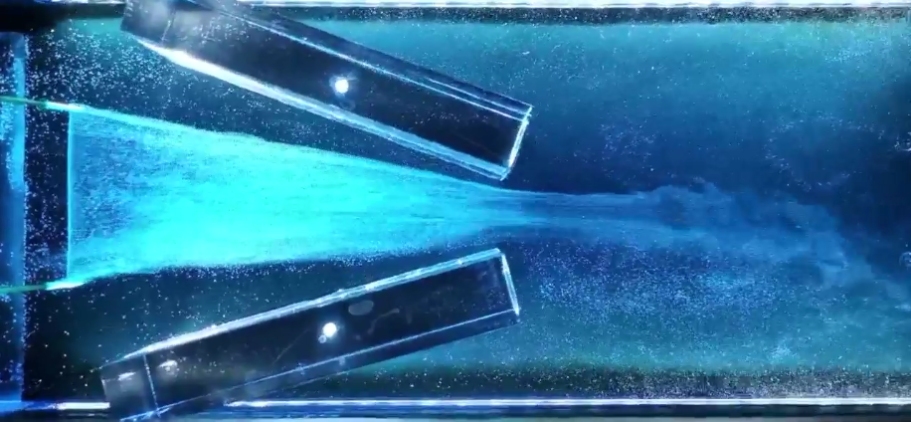
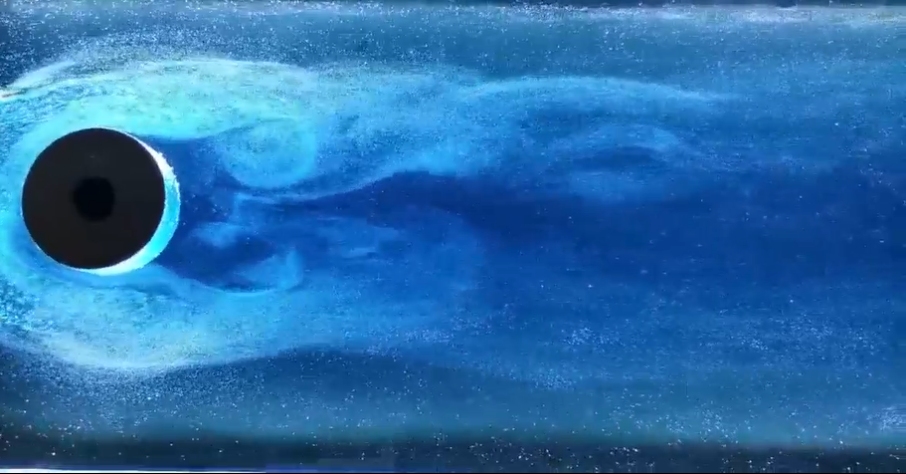
The device supports four core visualization experiments. In the boundary layer separation experiment, students place a NACA2412 airfoil in the flow and observe how the boundary layer detaches from the surface as speed increases, linking the phenomenon directly to aircraft stall. In the Karman vortex street experiment, a cylindrical model reveals periodic alternating vortex shedding downstream, teaching how Reynolds number influences vortex formation and its application in vortex flow meters. In the two dimensional flow visualization experiment, students swap between rectangular, S shaped, sudden expansion, sudden contraction, and parallel channel models to observe how geometry alters flow patterns. In the laminar and turbulent flow experiment, students adjust speed to observe the transition from smooth layered laminar flow to chaotic turbulent flow, building intuition for Reynolds number and flow regime. Across all experiments, students also learn electrolysis principles, the relationship between electrolyte concentration and conductivity, and the analogy between water and air flow based on Reynolds number similarity.
Beyond specific fluid mechanics concepts, the flow field visualization experimental device gives students the ability to connect theoretical equations with tangible visual evidence. The compact desktop design requires no additional facilities and can be set up on an ordinary classroom desk, making it accessible for small teaching laboratories. For Peking University College of Engineering, the device has become a core tool for fluid mechanics instruction, allowing students to see, question, and understand the invisible world of fluid motion.
Explore MicroNewton flow field visualization experimental device and other fluid mechanics teaching equipment. Contact us to discuss your laboratory requirements.