Case Studies
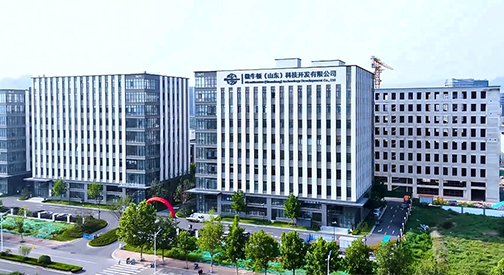
Flight Demonstration Wind Tunnel at Shandong University
Share:
JINAN, China: Shandong University has commissioned a flight demonstration wind tunnel from MicroNewton for its aeronautics and engineering teaching laboratories. Instead of holding a fixed model in a steady flow, the apparatus lets each learner operate a control stick and fly a wing model through lift, stall, and recovery, while a digital twin mirrors every movement on screen.
The tunnel combines a quiet subsonic flow channel, a transparent test section, lift and angle sensors, and a control stick linked to a digital twin display. Inside the section sits a model aircraft with a NACA 2412 main wing and a NACA 0012 tail. The operator at the stick is effectively flying the model rather than simply watching it.
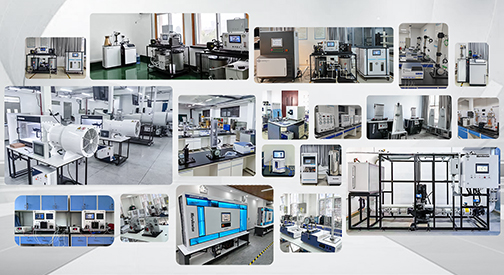
explore the full range of wind tunnel teaching equipment
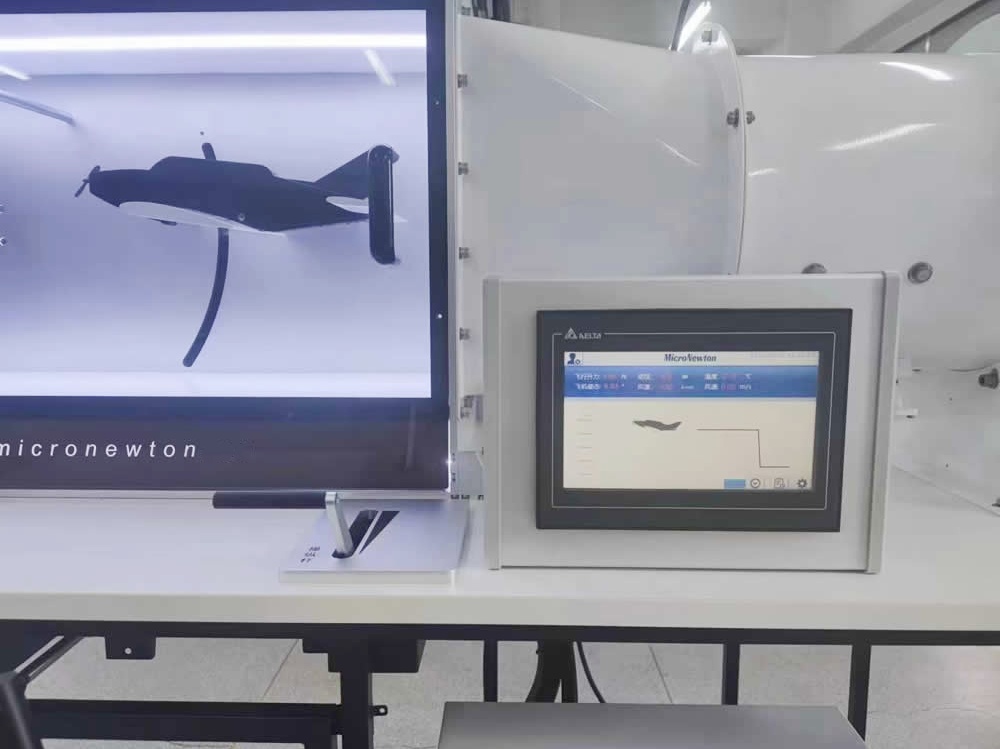
Before each run, the operator checks the model, sets the center of gravity, and reads the starting values on screen: wind speed, pressure, angle, and lift. A virtual aircraft beside the readings mirrors the physical model, so two versions of the same aircraft are visible at once.
When the variable frequency fan ramps up, the lift sensor records the force building under the wing. Pulling the stick rotates the model into a climb, and the virtual nose rises in step with the physical one, showing how angle of attack changes lift in real time. In cruise, the stick is trimmed for level flight and the tail angle is adjusted to explore longitudinal stability. Tuft wires along the wing show the airflow remaining attached, then breaking away as the wing approaches its stall point.
Push the angle too far and the wing stalls. Lift drops sharply, the model pitches downward, and the screen records the point where the lift curve bends over. Runs can continue by moving the center of gravity, correcting the measured curve, and locating the new balance point. Over longer runs, a slow phugoid oscillation appears as the model pitches and drifts in height.
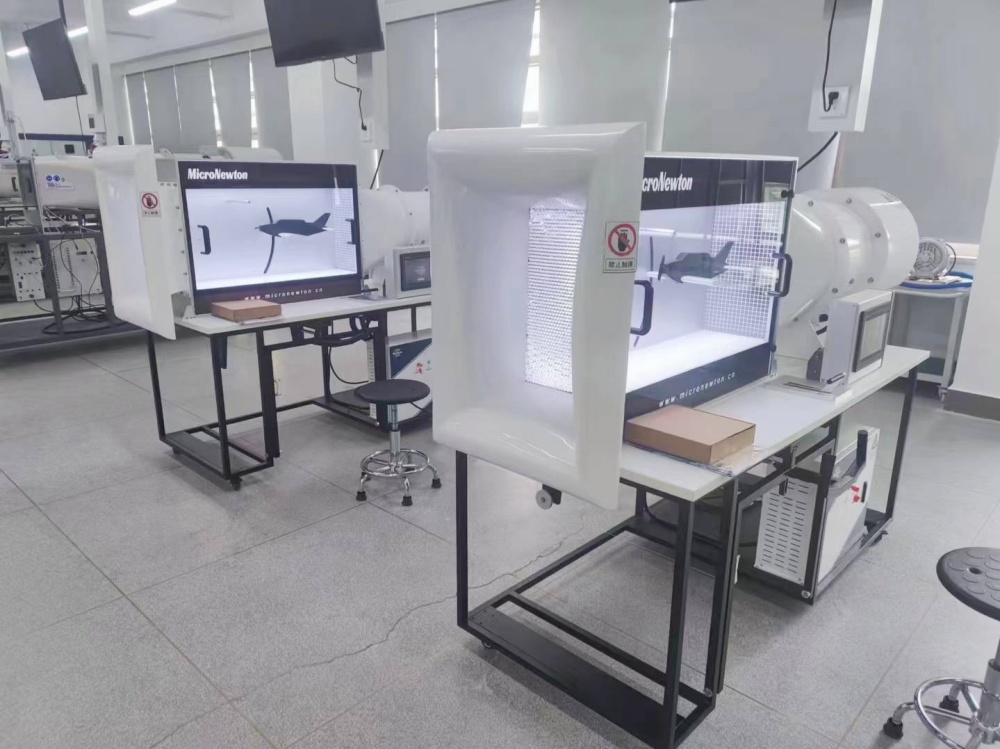
The apparatus serves aeronautical engineering, mechanical engineering, and general engineering students who need to connect aerodynamic theory with the feel of flight. Practical sessions cover:
Rather than memorizing the stall, learners cause one, watch it, and read the numbers it leaves behind.
Every component, from the turbulence suppression matrix and noise suppression measures to the variable frequency fan and digital twin screen, is arranged around one idea: the learner is an operator flying the aircraft, not a spectator reading a fixed model. That is how MicroNewton turns a wind tunnel from a measuring instrument into a flight lesson.
see the F116 wind tunnel series for universities seeking a compact subsonic option.
Explore MicroNewton flight demonstration and subsonic wind tunnel teaching equipment, and contact us to plan an aeronautics or aerodynamics laboratory for your university.
What is a flight demonstration wind tunnel?
It is a teaching wind tunnel where students operate a control stick to fly a NACA airfoil model in a subsonic flow. Lift and angle sensors feed a digital twin screen that mirrors the model throughout the flight.
What airfoils are used on the model aircraft?
A NACA 2412 main wing and a NACA 0012 tail, which are standard profiles in many introductory aerodynamics courses.
How do students demonstrate a stall?
They increase the angle of attack until the tuft wires show airflow separation, lift drops sharply, and the screen records the point where the lift curve bends over.
What is the digital twin display for?
It shows a virtual aircraft that mirrors the physical model in real time, so learners can watch wing attitude, pitch, and the lift curve together during each run.
Which stability experiments are possible?
Tail angle and elevator trim for longitudinal stability, center of gravity shifts, and observation of phugoid oscillation during longer runs.
Which university programs use the equipment?
Aeronautical engineering, mechanical engineering, and general engineering programs that connect aerodynamic theory with practical flight handling.