Custom Aviation Museum Wind Tunnel Brings Aerodynamics to Life at Northwestern Polytechnical University
Share:
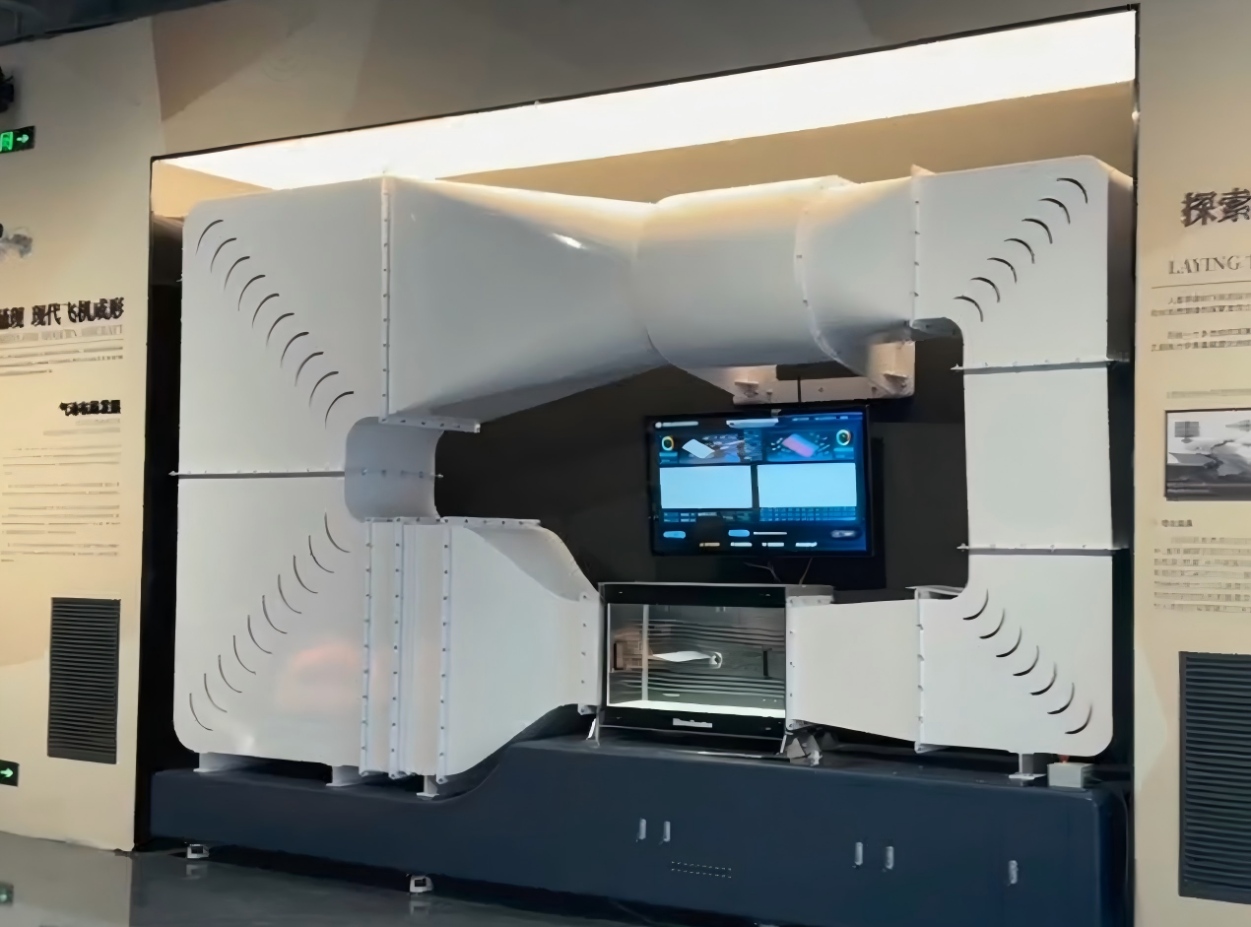
The Challenge. Northwestern Polytechnical University (NPU), a leader in aerospace engineering education, needed more than a standard laboratory wind tunnel. The university required a custom built aerodynamics demonstration wind tunnel for its aviation museum an exhibit grade system that could visually explain the principles of flight to the public while simultaneously supporting hands on student experiments. A conventional research wind tunnel was too large for a museum setting. MicroNewton delivered a tailored aviation museum aerodynamics principle demonstration wind tunnel designed specifically to meet this dual demand.
The Solution. Built as a low speed closed loop wind tunnel, the custom system measures 4.9 m long × 3.2 m high × 0.75 m deep and reaches a maximum wind speed of 30 m/s with precise 0-30 m/s adjustment. Its transparent test section and integrated display screen turn the wind tunnel itself into a teaching tool, revealing every internal stage the rectifier with honeycomb and damping mesh, the contraction section, the test section, the diffuser, the power section, and the corner guide vanes. A wall mounted design with bottom support saves floor space, turbulence is controlled to 2%, and overall noise stays under 60 dB, making the system suitable for a public museum environment.
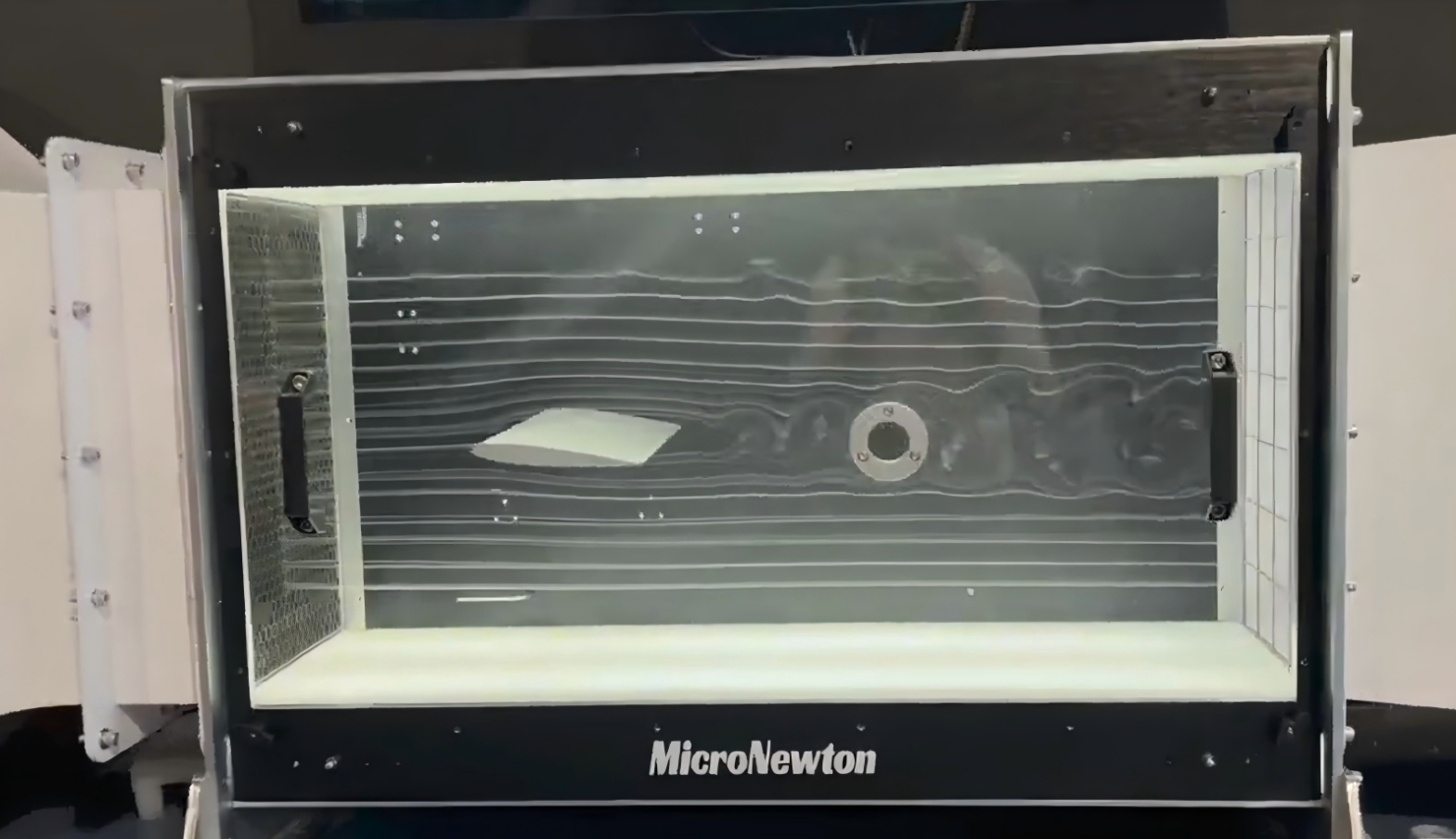
What Students Learn. The wind tunnel serves aerospace engineering students at undergraduate and postgraduate levels, alongside museum visitors. Through direct observation and measurement, students master core aerodynamics knowledge points: lift and drag forces, pitching moment, lift and drag coefficients, pressure distribution around airfoils, the influence of angle of attack, stall behaviour, and flow separation. The system supports testing of at least two airfoil models at varying wind speeds and angles of attack. A comb type smoke generator paired with a lighting system renders flow visualization possible, making airflow patterns and separation zones around the airfoil visible to the naked eye. A three component balance captures real time force data, while the control software displays dynamic curves lift, drag, and pitching moment versus angle of attack plus pressure distribution curves, and provides stall warnings and flow separation point indicators. Students can also record and review experimental data through the system's self evolution logging function.
The Outcome. By combining museum quality visualisation with research grade measurement, MicroNewton's custom demonstration wind tunnel gives NPU a single platform that educates, inspires, and experiments bridging aerodynamic theory and hands on practice for the next generation of aerospace engineers.
Looking for a custom wind tunnel solution for your museum, classroom, or research facility? Contact MicroNewton today to discuss your aerodynamics demonstration needs.