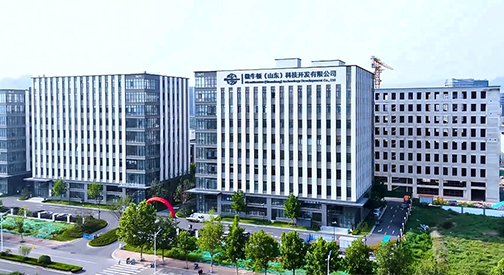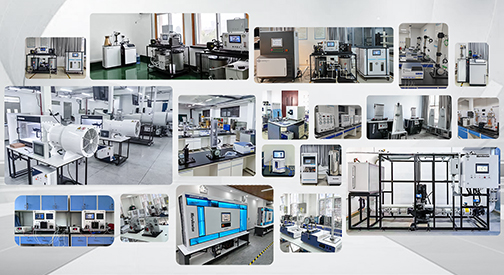
Aerodynamics Heat Transfer and Refrigeration Laboratory Delivered to Liaoning University of Science and Technology
Share:
Liaoning University of Science and Technology expanded its engineering teaching capacity with a comprehensive delivery spanning aerodynamics, heat transfer, and energy and environment product series. The package includes dozens of experiment stations that together support a broad undergraduate engineering laboratory curriculum. Among them, three representative pieces anchor the delivery: a free and forced convection experiment module for studying heat transfer from plates, pins, and fins, a vapor compression refrigeration cycle device for teaching thermodynamics and refrigeration principles, and the nozzle pressure distribution experiment apparatus, which became the focus of detailed laboratory design discussions.
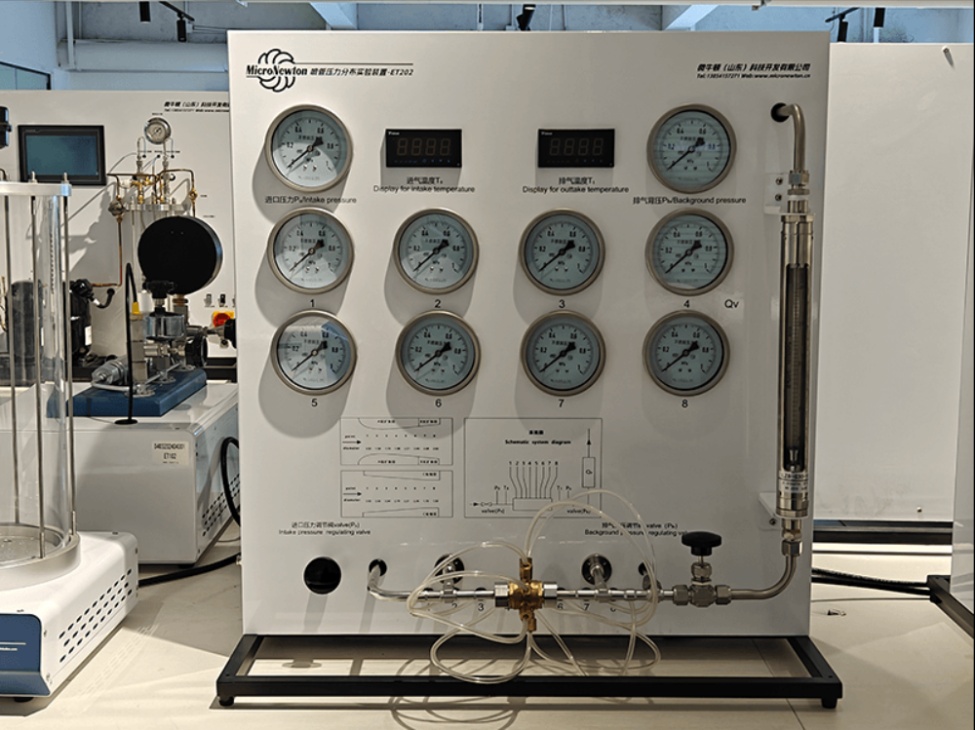
The nozzle pressure distribution experiment apparatus is a compact bench top unit that lets students observe compressible flow inside three interchangeable nozzles: one convergent nozzle and two convergent divergent Laval nozzles with different area ratios. The apparatus scales a large space aerodynamics experiment down to a laboratory bench, allowing students to independently set inlet pressure and back pressure while measuring pressure at multiple points along the nozzle wall.
The experiments supported by this apparatus directly address core aerodynamics teaching requirements. Students demonstrate the nozzle choking effect, where the throat reaches Mach one and mass flow can no longer increase regardless of back pressure. They study how inlet pressure changes the internal pressure profile, moving from fully subsonic flow to flows with normal shock waves inside the diverging section. They vary environmental back pressure and observe how shock wave position shifts toward the inlet as back pressure rises. By swapping nozzles with different area ratios, students compare how geometry controls the pressure distribution under the same pressure ratio. Finally, they identify overexpansion and underexpansion conditions and locate shock wave formation by detecting the sudden pressure jump along the nozzle.
Through these experiments, students connect theory to measurement: they work with Mach number, subsonic and supersonic flow regimes, stagnation and critical states, quasi one dimensional isentropic flow assumptions, and shock wave behavior. The apparatus uses air or nitrogen and supports independent student operation, which makes it well suited for teaching laboratories where every student needs hands on data.
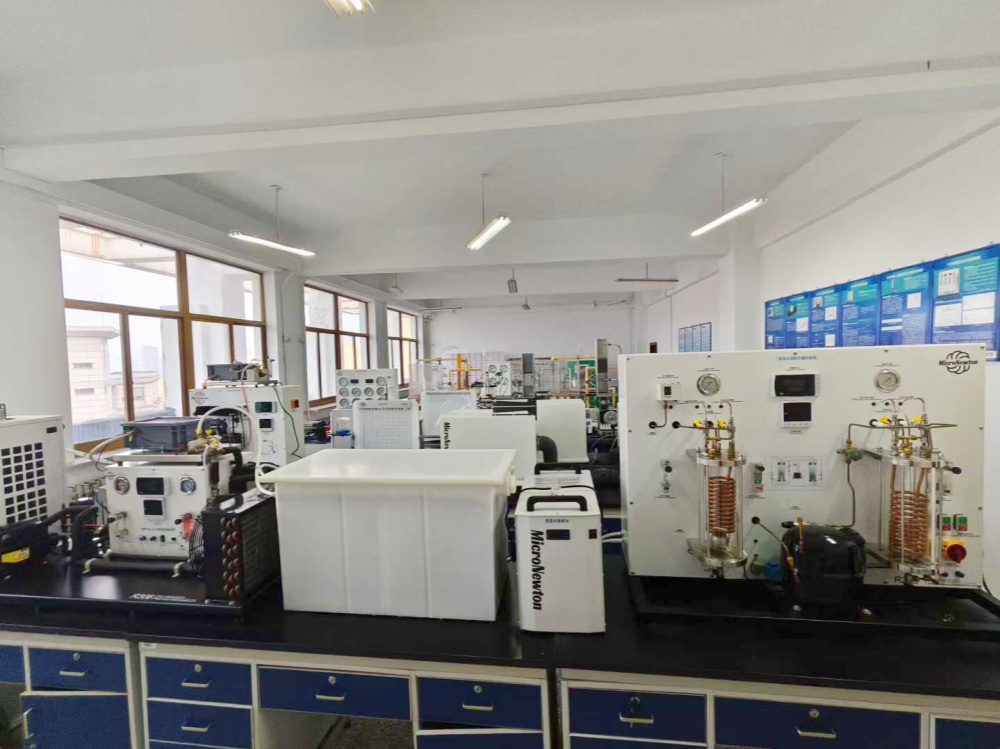
The free and forced convection module rounds out the heat transfer side of the delivery. Students compare convective heat transfer from flat plates, pin fins, and extended surfaces under natural and forced air flow, measuring how geometry and flow speed change heat transfer rates. The vapor compression refrigeration cycle device gives students hands on access to the compression, condensation, expansion, and evaporation processes that define practical cooling systems, and lets them observe how pressures and temperatures move around the cycle.
Taken together, these delivered stations form a coherent engineering laboratory collection. It trains mechanical engineering, energy and power engineering, aerospace engineering, and applied thermal engineering students. It satisfies teaching requirements in compressible fluid mechanics, convective heat transfer, and refrigeration and heat pump technology. The experiments achievable on this equipment span subsonic and supersonic nozzle flow, shock wave observation, choking phenomenon, fin and plate convection, and the complete vapor compression cycle. Students leave with practical skills in pressure measurement, data logging, curve plotting, and comparing experimental results against textbook gas dynamics theory.
By combining aerodynamics, heat transfer, and refrigeration stations in one delivery, MicroNewton has given Liaoning University of Science and Technology a flexible laboratory foundation that supports core required courses and leaves room for advanced student projects.
Explore MicroNewton aerodynamics, heat transfer, and energy environment teaching equipment. Contact us to design a laboratory collection for your institution.